


Traditional Firewall vs. Transparent (Bridged) Firewall
When it comes to securing your network, one of the key decisions you'll face is whether to use a traditional firewall or a transparent bridged firewall. Both approaches have their own unique advantages and use cases, and understanding the differences between them can help you make an informed choice based on your specific network requirements and security objectives. In this detailed comparison, we'll explore the reasons why you might choose a transparent bridged firewall over a traditional firewall and vice versa.
Traditional Firewall:
A traditional firewall acts as a gateway between two or more networks, typically sitting at the edge of a network and controlling the flow of traffic in and out. It operates at Layer 3 (Network Layer) and Layer 4 (Transport Layer) of the OSI model, inspecting packets based on IP addresses, ports, and protocols.
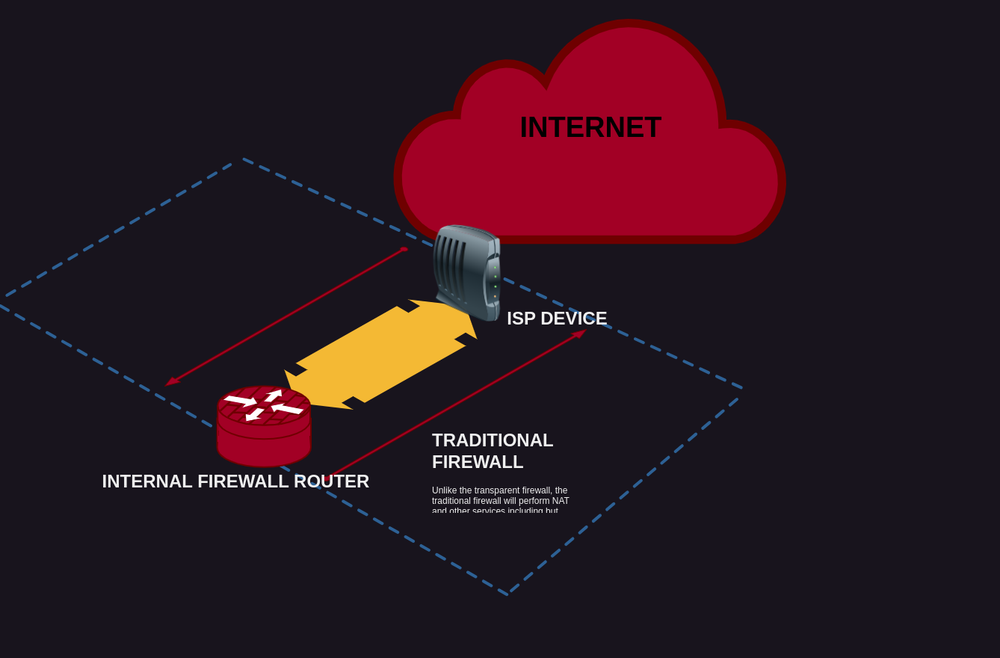
Advantages of Traditional Firewalls:Traditional Firewall:
- Clear Segmentation: Traditional firewalls provide a clear separation between the trusted internal network and the untrusted external network (e.g., the Internet). This segmentation helps in enforcing security policies and controlling access to resources.
- Granular Control: Traditional firewalls offer granular control over network traffic, allowing you to define specific rules based on IP addresses, ports, and protocols. This level of control enables you to permit or deny traffic based on your security requirements.
- Network Address Translation (NAT): Traditional firewalls often include NAT functionality, which allows you to hide the internal network structure and conserve public IP addresses. NAT provides an additional layer of security by masking the internal IP addresses from the outside world.
- VPN Termination: Many traditional firewalls support Virtual Private Network (VPN) termination, enabling secure remote access to the internal network. This feature is particularly useful for remote employees or branch offices that need to connect securely to the main network.
Transparent Bridged Firewall:
A transparent bridged firewall, also known as a Layer 2 firewall or a bridge mode firewall, operates at Layer 2 (Data Link Layer) of the OSI model. It acts as a transparent bridge between two network segments, inspecting and filtering traffic without modifying the IP addresses or performing routing functions.
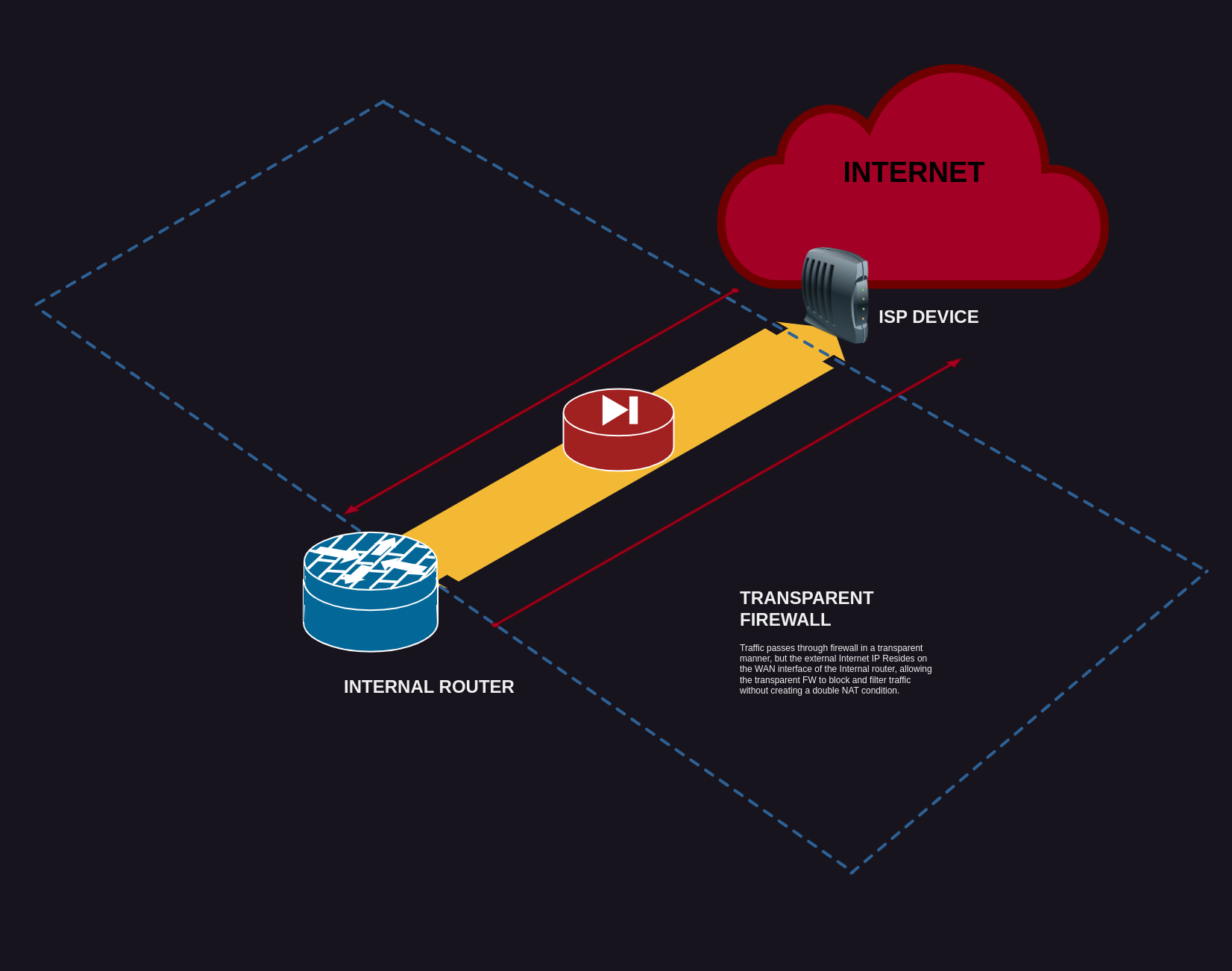
Advantages of Transparent Bridged Firewalls:
- Invisibility: Transparent bridged firewalls are virtually invisible to the network. They do not require any changes to the existing network configuration, such as IP address assignments or default gateway settings. This makes them easier to deploy and maintain, especially in complex network environments.
- Simplified Integration: Since transparent bridged firewalls operate at Layer 2, they can be seamlessly inserted into existing network segments without requiring any modifications to the network topology. This simplifies the integration process and minimizes disruption to the network.
- Stealth Mode: Transparent bridged firewalls operate in a stealth mode, making them less detectable by potential attackers. They do not have an IP address visible to the outside world, reducing the attack surface and making it harder for attackers to target the firewall directly.
- Flexibility: Transparent bridged firewalls can be deployed in various network scenarios, such as protecting specific network segments, securing virtual environments, or creating a security perimeter around critical assets. They provide flexibility in terms of placement and can be easily moved or reconfigured as network requirements change.
- Performance: Since transparent bridged firewalls operate at Layer 2, they can handle high-speed traffic without introducing significant latency. They do not perform complex routing decisions, resulting in faster packet processing and better overall performance compared to traditional firewalls.
Contrasting Use Cases:
- Network Segmentation: If your primary goal is to create distinct network segments with clear boundaries and enforce strict access controls between them, a traditional firewall is often the better choice. Traditional firewalls excel at segmenting networks and enforcing granular security policies based on IP addresses and ports.
- Seamless Integration: If you have a complex network environment where introducing a traditional firewall would require significant changes to the network configuration, a transparent bridged firewall may be preferable. Transparent bridged firewalls can be inserted into existing network segments without modifying IP addresses or default gateway settings, simplifying the integration process.
- Stealth and Invisibility: If you prioritize stealth and want to minimize the visibility of your security measures, a transparent bridged firewall offers advantages. By operating at Layer 2 and not having an IP address, transparent bridged firewalls are less detectable and provide an additional layer of obscurity.
- Performance Requirements: If your network demands high-speed traffic processing and minimal latency, a transparent bridged firewall may be the better option. Transparent bridged firewalls operate at Layer 2 and do not perform complex routing decisions, resulting in faster packet processing compared to traditional firewalls.
- VPN Termination: If secure remote access is a critical requirement for your network, a traditional firewall with VPN termination capabilities may be the preferred choice. Traditional firewalls often include built-in VPN functionality, allowing remote users to securely connect to the internal network.
Ultimately, the decision between a traditional firewall and a transparent bridged firewall depends on your specific network requirements, security objectives, and the complexity of your environment. It's essential to assess your needs carefully and consider factors such as network segmentation, integration ease, stealth, performance, and remote access requirements.
In some cases, a hybrid approach that combines both traditional and transparent bridged firewalls can be advantageous. This allows you to leverage the strengths of each type of firewall in different parts of your network, providing a comprehensive and tailored security solution.
Regardless of your choice, it's crucial to regularly review and update your firewall configuration to ensure it aligns with evolving security threats and business requirements. Regularly monitoring firewall logs, conducting security audits, and staying informed about emerging threats will help you maintain a robust and effective firewall deployment.
Zenarmor
In the ever-evolving landscape of network security, organizations are constantly seeking solutions to fortify their defenses against sophisticated threats. One such solution that has gained significant attention is Zenarmor, a comprehensive firewall and security plugin that seamlessly integrates with OPNsense, a popular open-source firewall platform. In this detailed write-up, we will explore the features, strengths, and weaknesses of Zenarmor and discuss why adding it as a plugin to OPNsense or deploying it as a standalone system can significantly enhance the security controls within an environment.
Features and Capabilities:
- Advanced Firewall Rules: Zenarmor provides a powerful and intuitive interface for creating and managing complex firewall rules. It offers a wide range of options for filtering traffic based on source and destination IP addresses, ports, protocols, and more. The granular control over network traffic allows administrators to enforce strict security policies and prevent unauthorized access.
- Application-Level Filtering: Zenarmor goes beyond traditional port-based filtering by incorporating application-level awareness. It can identify and control specific applications, such as web browsers, email clients, and file-sharing programs, enabling administrators to enforce application-specific policies and prevent the misuse of network resources.
- Intrusion Detection and Prevention (IDS/IPS): Zenarmor includes a robust intrusion detection and prevention system that monitors network traffic for suspicious activities and known attack patterns. It utilizes a combination of signature-based and anomaly-based detection techniques to identify and block potential security breaches in real-time.
- Web Filtering and Content Control: With Zenarmor, administrators can implement web filtering policies to restrict access to inappropriate or malicious websites. It offers categories-based filtering, URL blacklisting, and whitelisting options to ensure that users can only access safe and authorized web content.
- Geo-IP Filtering: Zenarmor supports geo-IP filtering, allowing administrators to control traffic based on geographic locations. This feature enables the blocking of traffic from specific countries or regions known for high levels of cyber threats, reducing the risk of attacks originating from those areas.
- VPN Integration: Zenarmor seamlessly integrates with OPNsense's VPN capabilities, providing secure remote access to the network. It supports various VPN protocols, including OpenVPN, IPsec, and WireGuard, ensuring secure and encrypted communication channels for remote users.
- Logging and Reporting: Zenarmor generates detailed logs and reports of network activities, including firewall events, intrusion attempts, and web access logs. These logs provide valuable insights into network traffic patterns, security incidents, and user behavior, aiding in troubleshooting, forensic analysis, and compliance reporting.
Strengths:
- intrusion detection and prevention, web filtering, and VPN integration. This comprehensive approach provides a multi-layered defense against various types of network threats.
- Seamless Integration with OPNsense: Zenarmor is designed to integrate seamlessly with OPNsense, leveraging its underlying security capabilities and user interface. This integration allows administrators to manage Zenarmor's features and policies from within the familiar OPNsense web interface, reducing the learning curve and simplifying security management.
- Granular Control and Flexibility: Zenarmor provides granular control over network traffic, enabling administrators to create highly specific and tailored security policies. Its flexibility allows for the customization of rules based on unique organizational requirements, ensuring that security measures align with business needs.
- Real-time Threat Detection and Prevention: With its intrusion detection and prevention system, Zenarmor can identify and block threats in real-time. This proactive approach minimizes the window of opportunity for attackers and helps prevent successful intrusions before they cause significant damage.
- Extensive Logging and Reporting: Zenarmor's logging and reporting capabilities provide valuable insights into network activities and security events. These logs serve as a crucial tool for incident response, forensic analysis, and compliance auditing, enabling administrators to detect anomalies, investigate security incidents, and generate detailed reports.
Weaknesses:
- Resource Overhead: Implementing Zenarmor as a plugin or standalone system may introduce additional resource overhead on the firewall hardware. The advanced features and real-time threat detection capabilities may require more processing power and memory, potentially impacting overall system performance in resource-constrained environments.
- False Positives: Like any intrusion detection system, Zenarmor may generate false positives, flagging legitimate traffic as potential threats. While false positives are an inherent challenge in security solutions, they can lead to unnecessary alerts and require manual intervention to investigate and whitelist legitimate traffic.
- Maintenance and Updates: Deploying Zenarmor adds another component to the security infrastructure that requires regular maintenance and updates. Administrators must stay vigilant in applying security patches, updating signature databases, and monitoring the system for optimal performance and effectiveness.
- Learning Curve: While Zenarmor integrates well with OPNsense, administrators may still need to familiarize themselves with its specific features, configuration options, and rule creation process. This learning curve can be steeper for those new to advanced firewall and security concepts.
Licensing Tiers:
Zenarmor offers different pricing and licensing models to cater to the diverse needs of organizations, from lab environments to enterprise-level deployments. If you want to learn more specifics on the various options and pricing you can go to Zenarmor's Plans page to learn more. Here's a quick breakdown of Zenarmor's pricing and licensing models, along with specific recommendations for lab environments and enterprises:
Free Edition:
- Limited Time-based Trial Period
- Zenarmor provides a Free Edition that includes basic features and functionalities.
- It is suitable for initial evaluation.
- The Free Edition has limitations on the number of devices, bandwidth, and certain advanced features.
- It does not include technical support or access to regular updates and security patches.
Home Edition:
- Everything from Free Edition, plus
- Advanced Security
- Up to 3 Filtering Policies
- Unlimited Web Filtering
- It is suitable for personal use, small lab environments, or testing purposes.
- Only for non-commercial use
SOHO Edition:
- Everything from Free Edition, plus
- Advanced Security
- Up to 5 Filtering Policies
- Unlimited Web Filtering
- RESTful API
- The SOHO Edition is designed for small to medium-sized businesses or larger lab environments.
- It offers expanded features and capabilities compared to the SOHO Edition.
- The pricing for the SOHO Edition is based on the number of devices or bandwidth requirements.
- It includes technical support, regular updates, and security patches.
- The SOHO Edition provides access to advanced features such as application-level filtering, intrusion detection and prevention, and VPN integration.
Business Edition:
- Everything from Free Edition, plus
- Advanced Security
- Unlimited Filtering Policies
- Unlimited Web Filtering
- RESTful API
- Unlimited Cloud Management
- Unlimited User Based Filtering
- Active Directory Integration
- Bundled Basic Support
- Business & Enterprise Support Options
- The Business Edition is tailored for large-scale deployments and enterprise-level requirements.
- It offers the full range of Zenarmor's features and capabilities, including advanced security controls, high availability options, and centralized management.
- The pricing for the Business Edition is customized based on the specific needs of the organization, taking into account factors such as the number of devices, bandwidth, and desired support level.
- It includes dedicated technical support, priority updates and security patches, and access to enterprise-specific features and integrations.
- The Business Edition often involves a custom licensing agreement and may include additional services such as training, consulting, and ongoing support.
Recommendations:
For Lab Environments:
- If you have a small lab setup or are using Zenarmor for personal testing and learning purposes, the Free Edition or Home Edition may suffice. It provides basic functionality and allows you to explore the core features of Zenarmor.
- However, if your lab environment is more complex or requires advanced features and regular updates, the SOHO Edition would be a better choice. It offers expanded capabilities and includes technical support, ensuring that your lab environment stays up to date and secure.
For Enterprises:
- For enterprise-level deployments, the Business Edition is the recommended choice. It provides the full range of Zenarmor's features and capabilities, along with dedicated support and customization options.
- The Business Edition is designed to handle large-scale deployments, high traffic volumes, and complex security requirements. It offers advanced security controls, high availability options, and centralized management, making it suitable for mission-critical environments.
- Enterprises can benefit from the customized pricing and licensing agreements, which take into account their specific needs and requirements. The dedicated technical support and priority updates ensure that the enterprise's security posture remains strong and up to date.
It's important to note that the specific pricing details and feature inclusions may vary based on Zenarmor's latest offerings and pricing structure. It's recommended to reach out to Zenarmor's sales team or refer to their official website for the most up-to-date information on pricing, licensing, and feature comparisons.
Ultimately, the choice between the different editions depends on your organization's size, security requirements, budget, and the complexity of your network infrastructure. It's crucial to assess your needs carefully and engage with Zenarmor's sales representatives to determine the most suitable licensing model for your specific scenario, whether it's a lab environment or an enterprise-level deployment.
Value Add to Security Controls:
Adding Zenarmor as a plugin to OPNsense or deploying it as a standalone system significantly enhances the security controls within an environment. By complementing OPNsense's existing firewall capabilities with Zenarmor's advanced features, organizations can achieve a more robust and comprehensive security posture.
Zenarmor's application-level filtering and web content control features enable administrators to enforce granular policies, preventing the misuse of network resources and reducing the risk of malware infections and data exfiltration. Its intrusion detection and prevention system acts as a vital line of defense, identifying and blocking sophisticated attacks that may evade traditional firewall rules.
Moreover, Zenarmor's logging and reporting capabilities provide valuable visibility into network activities, enabling administrators to detect anomalies, investigate security incidents, and demonstrate compliance with regulatory requirements. The detailed insights gained from Zenarmor's logs can help organizations identify security gaps, optimize their security policies, and make informed decisions to strengthen their overall security posture.
Zenarmor is a powerful and comprehensive security solution that offers advanced firewall capabilities, intrusion detection and prevention, web filtering, and VPN integration. By adding Zenarmor as a plugin to OPNsense or deploying it as a standalone system, organizations can significantly enhance their security controls and create a multi-layered defense against evolving cyber threats.
While Zenarmor's advanced features may introduce some resource overhead and require regular maintenance, its benefits in terms of granular control, real-time threat detection, and extensive logging and reporting make it a valuable addition to any security infrastructure. The seamless integration with OPNsense and the ability to customize policies based on unique organizational requirements further strengthen its appeal.
Ultimately, the decision to implement Zenarmor depends on an organization's specific security needs, resources, and risk tolerance. However, for those seeking to fortify their network defenses and gain deeper visibility into security events, Zenarmor stands as a compelling choice. By leveraging its advanced capabilities and integrating it with OPNsense, organizations can take a proactive approach to network security and better protect their critical assets from the ever-evolving threat landscape.
CrowdSec
Similarly, organizations face the daunting challenge of protecting their networks from a wide range of attacks. Traditional security solutions often rely on isolated threat intelligence, leaving networks vulnerable to emerging and unknown threats. CrowdSec, an innovative open-source security platform, aims to address this gap by leveraging the power of collaborative threat intelligence. In this detailed write-up, we will explore the features, strengths, and weaknesses of CrowdSec and discuss why adding it as a plugin to OPNsense can significantly enhance network security.
Licensing Tiers:
CrowdSec offers different pricing and licensing models to cater to various use cases and organizations of different sizes. If you want to learn more specifics on the various options and pricing you can go to CrowdSec's Pricing page to learn more. Here's a breakdown of CrowdSec's pricing and licensing models, along with recommendations for lab environments and other plans:
Community Plan:
- Daily crowdsourced blocklist updates
- Detection scenarios
- Remediation components
- Third-party blocklists
- 7 Days data retention
- Community support
- CrowdSec provides a community plan that is suitable for personal use, small lab environments, or testing purposes.
- The community plan includes the core features of CrowdSec, such as collaborative threat intelligence, behavioral analysis, and autonomous threat response.
- It allows for a limited number of agents (up to 5) and a restricted volume of data processing.
- The community plan does not include commercial support or access to advanced features and integrations.
- It is an ideal choice for individuals or small teams who want to explore and evaluate CrowdSec's capabilities.
CrowdSec Blocklist Subscription:
- Get proactive CrowdSec protection
- Real-life crowdsourced updates
- Ultra-curated data
- 5% daily rotation
- Proactive tactical intelligence
- This subscription is a standalone package for the CrowdSec protection data, and it is independent of the Community and Enterprise plans.
CrowdSec Threat Intelligence Subscription:
- Get only the CrowdSec protection data
- Crowdsourced intelligence
- Contextualized data
- Enhanced API queries
- Predictive threat intelligence
- Multi-source CTI
- Easy integration
- Offline replication
- This subscription is a standalone package for the CrowdSec protection data, and it is independent of the Community and Enterprise plans.
Enterprise Plan:
- Upgrades all features in the Community plan plus:
- Real-time crowdsourced blocklist updates
- Unlimited premium blocklists
- Centralized management
- Private consensus
- Multiple organizations
- Unlimited Users
- One-year data retention
- Live support
- The Enterprise plan is designed for large-scale enterprises with complex security needs and demanding requirements.
- The Enterprise plan provides a fully customized deployment, including on-premises installation and integration with existing security infrastructure.
- It offers 24/7 priority support, custom SLAs, and dedicated technical account management.
- The pricing for the Enterprise plan is tailored to the specific needs of the organization and requires a custom quote.
Recommendations:
Ultimately, the choice of plan depends on your specific requirements, budget, and the scale of your environment. For personal use or small lab environments, the Community Plan offers a good starting point with core features and limited resources. Organizations seeking enhanced protection and intelligence can consider the standalone CrowdSec Blocklist Subscription and CrowdSec Threat Intelligence Subscription. For large-scale enterprises with complex security needs, the Enterprise Plan provides advanced features, customization options, and dedicated support.
For Personal Use, Small Lab Environments, or Testing Purposes:
- The Community Plan is the most suitable option for individuals or small teams who want to explore and evaluate CrowdSec's capabilities.
- It includes the core features of CrowdSec, such as collaborative threat intelligence, behavioral analysis, and autonomous threat response.
- The Community Plan allows for a limited number of agents (up to 5) and a restricted volume of data processing, which should be sufficient for personal use or small lab environments.
- While it does not include commercial support or access to advanced features, the Community Plan offers daily crowdsourced blocklist updates, detection scenarios, remediation components, and third-party blocklists.
- With 7 days of data retention and community support, the Community Plan provides a good starting point for those new to CrowdSec.
For Organizations Seeking Enhanced Protection and Intelligence:
- The CrowdSec Blocklist Subscription and CrowdSec Threat Intelligence Subscription are standalone packages that offer additional protection and intelligence capabilities.
- These subscriptions are independent of the Community and Enterprise plans and can be beneficial for organizations looking to enhance their security posture.
- The CrowdSec Blocklist Subscription provides proactive CrowdSec protection with real-life crowdsourced updates, ultra-curated data, 5% daily rotation, and proactive tactical intelligence.
- The CrowdSec Threat Intelligence Subscription offers crowdsourced intelligence, contextualized data, enhanced API queries, predictive threat intelligence, multi-source CTI, easy integration, and offline replication.
- Organizations can consider subscribing to these packages based on their specific security requirements and the need for advanced threat protection and intelligence.
For Large-Scale Enterprises with Complex Security Needs:
- The Enterprise Plan is tailored for large-scale enterprises with complex security needs and demanding requirements.
- It upgrades all features in the Community Plan and includes additional advanced capabilities.
- The Enterprise Plan offers real-time crowdsourced blocklist updates, unlimited premium blocklists, centralized management, private consensus, support for multiple organizations, unlimited users, and one-year data retention.
- It provides a fully customized deployment, including on-premises installation and integration with existing security infrastructure.
- With 24/7 priority support, custom SLAs, and dedicated technical account management, the Enterprise Plan ensures comprehensive support and assistance for large-scale deployments.
- The pricing for the Enterprise Plan is tailored to the specific needs of the organization and requires a custom quote, taking into account the complexity and scale of the deployment.
It's important to note that the specific pricing details and feature inclusions may vary based on CrowdSec's latest offerings and pricing structure. It's recommended to visit CrowdSec's official website or contact their sales team for the most up-to-date information on pricing, licensing, and feature comparisons.
As previously stated, the choice of plan depends on your organization's size, security requirements, budget, and the complexity of your environment. It's crucial to assess your needs carefully and select the plan that aligns with your goals and provides the necessary features and support for your specific use case.
Features and Capabilities:
- Collaborative Threat Intelligence: Crowdsec's core feature is its collaborative approach to threat intelligence. It allows organizations to share and benefit from the collective knowledge of a global community of security experts and users. By aggregating and analyzing threat data from multiple sources, Crowdsec provides real-time visibility into emerging threats and enables proactive defense measures.
- Behavioral Analysis: Crowdsec employs advanced behavioral analysis techniques to detect and identify malicious activities. It monitors network traffic, system logs, and user behavior patterns to identify anomalies and potential security breaches. By analyzing the behavior of entities interacting with the network, Crowdsec can detect sophisticated attacks that may evade traditional signature-based detection methods.
- Autonomous Threat Response: Crowdsec goes beyond mere threat detection by providing autonomous threat response capabilities. When a threat is identified, Crowdsec can automatically trigger predefined actions, such as blocking malicious IP addresses, quarantining infected devices, or alerting security teams. This autonomous response mechanism allows for swift and effective containment of threats, minimizing the potential impact on the network.
- Integration with OPNsense: Crowdsec seamlessly integrates with OPNsense, a powerful open-source firewall and routing platform. By adding Crowdsec as a plugin to OPNsense, organizations can enhance their network security posture by leveraging the combined capabilities of both solutions. Crowdsec's threat intelligence feeds and behavioral analysis can be used to dynamically update OPNsense's firewall rules, ensuring real-time protection against identified threats.
- Scalability and Flexibility: Crowdsec is designed to be highly scalable and flexible, making it suitable for networks of various sizes and complexities. It can handle large volumes of data and can be easily integrated into existing security infrastructures. Crowdsec's modular architecture allows organizations to cuConclusionstomize and extend its functionality to meet their specific security requirements.
Strengths:
- Collaborative Threat Intelligence: Crowdsec's collaborative approach to threat intelligence is a significant strength. By leveraging the collective knowledge and expertise of a global community, organizations can stay ahead of emerging threats and benefit from the experiences of others. This collaborative model enables faster detection and response to new and evolving attacks.
- Proactive Defense: Crowdsec's behavioral analysis capabilities allow for proactive defense against threats. By identifying anomalies and suspicious patterns in real-time, Crowdsec enables organizations to detect and respond to potential security breaches before they cause significant damage. This proactive approach helps in mitigating the risk of successful attacks and minimizing the impact on network operations.
- Autonomous Threat Response: Crowdsec's autonomous threat response mechanism is a valuable feature that enables swift and effective containment of threats. By automatically triggering predefined actions based on identified threats, Crowdsec reduces the time between detection and response, minimizing the window of opportunity for attackers to exploit vulnerabilities.
- Integration with OPNsense: The seamless integration of Crowdsec with OPNsense is a significant advantage. By combining the capabilities of both solutions, organizations can achieve a more comprehensive and robust security posture. Crowdsec's threat intelligence feeds can be used to dynamically update OPNsense's firewall rules, providing real-time protection against identified threats.
Weaknesses:
- False Positives: Like any threat detection system, Crowdsec may generate false positives, flagging legitimate activities as potential threats. False positives can lead to unnecessary alerts and require manual investigation, which can be time-consuming and resource-intensive. However, Crowdsec's collaborative model and continuous refinement of threat intelligence help minimize the occurrence of false positives over time.
- Dependency on Community Participation: Crowdsec's effectiveness relies heavily on the active participation and contribution of its user community. The quality and relevance of threat intelligence depend on the willingness of organizations to share their threat data and insights. If community participation is low or biased, it may impact the overall effectiveness of Crowdsec's collaborative threat intelligence.
- Privacy Concerns: Sharing threat intelligence across organizations raises potential privacy concerns. While Crowdsec takes measures to ensure the anonymity and confidentiality of shared data, some organizations may be hesitant to participate in the collaborative model due to legal or regulatory constraints. It is crucial for Crowdsec to maintain strict data privacy and security standards to foster trust among its user community.
Why Add Crowdsec as a Plugin to OPNsense:
Adding Crowdsec as a plugin to OPNsense offers several compelling reasons to enhance network security:
- Enhanced Threat Detection: Crowdsec's collaborative threat intelligence and behavioral analysis capabilities complement OPNsense's existing security features. By integrating Crowdsec, OPNsense gains access to a vast repository of threat data and real-time insights, enabling more accurate and timely detection of potential security breaches.
- Automated Threat Response: Crowdsec's autonomous threat response mechanism seamlessly integrates with OPNsense's firewall functionalities. When a threat is detected, Crowdsec can automatically trigger firewall rules to block malicious traffic or quarantine infected devices. This automation streamlines the threat response process and reduces the burden on security teams.
- Continuous Protection: Crowdsec's continuous updates and refinements to its threat intelligence ensure that OPNsense stays protected against the latest threats. As new attack patterns and indicators of compromise are identified by the Crowdsec community, OPNsense's firewall rules can be automatically updated to provide ongoing protection.
- Simplified Deployment and Management: Adding Crowdsec as a plugin to OPNsense simplifies the deployment and management of the collaborative threat intelligence solution. Organizations can leverage their existing OPNsense infrastructure and benefit from a unified security management interface. This integration reduces complexity and lowers the barriers to adopting advanced threat detection capabilities.
Crowdsec is a powerful open-source security platform that leverages collaborative threat intelligence to enhance network security. By combining behavioral analysis, autonomous threat response, and integration with OPNsense, Crowdsec offers organizations a comprehensive and proactive approach to defending against evolving cyber threats.
The strengths of Crowdsec lie in its collaborative model, proactive defense capabilities, and seamless integration with OPNsense. These features enable organizations to benefit from the collective knowledge of a global security community, detect threats in real-time, and automate threat response actions.
However, it is important to consider the potential weaknesses, such as false positives and dependency on community participation. Organizations should carefully evaluate their security requirements, privacy concerns, and resource availability before implementing Crowdsec.
Overall, adding Crowdsec as a plugin to OPNsense provides a valuable addition to an organization's security arsenal. By leveraging the combined capabilities of both solutions, organizations can strengthen their network security posture, reduce the risk of successful attacks, and enhance their overall cyber resilience.
As with any security solution, it is crucial to regularly monitor and assess the effectiveness of Crowdsec and OPNsense, and to continually adapt and refine the security strategy based on evolving threats and organizational needs. By staying vigilant and proactive, organizations can harness the power of collaborative threat intelligence to safeguard their networks and protect their critical assets in the ever-changing cyber landscape.
Conclusion
In conclusion, understanding the differences between traditional firewalls and transparent bridged firewalls is crucial for making informed decisions about network security. Traditional firewalls excel at network segmentation, granular control, and VPN termination, while transparent bridged firewalls offer seamless integration, stealth, and high-speed performance. Zenarmor and CrowdSec are two powerful security solutions that can significantly enhance the capabilities of OPNsense, an open-source firewall platform. Zenarmor provides advanced features such as application-level filtering, intrusion detection and prevention, and web filtering, while CrowdSec leverages collaborative threat intelligence to detect and respond to emerging threats proactively. By carefully evaluating your organization's security requirements and considering factors such as network complexity, performance needs, and budget, you can choose the most suitable firewall approach and leverage the strengths of Zenarmor and CrowdSec to fortify your security posture.
In the next article, we will dive into the practical implementation of both traditional and transparent bridged firewalls using OPNsense. We will explore the step-by-step configuration process for integrating Zenarmor and CrowdSec plugins, as well as setting up additional security tools like ClamAV for antivirus protection, Maltrail for malicious traffic detection, and IDS/IPS for intrusion detection and prevention. By combining these powerful tools with the robust features of OPNsense, you'll gain hands-on experience in creating a comprehensive and multi-layered security solution tailored to your organization's needs. Stay tuned for this exciting and informative guide on configuring firewalls and enhancing your network security with cutting-edge open-source technologies.


